

TL;DR: Undocumented systems and processes create a hidden risk for IT directors: when knowledge lives only in one person's head, handovers, incident response and change management all slow down. Co-managed IT support gives internal teams the capacity to build documentation that actually reflects reality, without taking ownership away from the people who know the environment best.
The risk nobody puts on a spreadsheet
Not every risk in an IT environment comes from a piece of technology. Some of the biggest ones come from how much of that environment exists only in one person's head.
As an IT director, you carry a huge amount of context. You know why a server was configured a certain way three years ago. You know which systems need careful handling and which ones can be left alone. You know which supplier relationship is fragile and which one just works.
That knowledge is exactly what makes you effective. It's also a dependency that most businesses across Chester, Warrington, Wrexham and the wider North West don't fully appreciate until it becomes a problem.
Where documentation usually falls down
Talk to enough IT directors and a pattern shows up quickly. Some parts of the environment are documented well. Others are patchy, out of date, or were never written down because keeping things running took priority over recording how they run.
That's not a criticism of anyone's discipline. When the working day is already full, documentation is one of the first tasks to get pushed to tomorrow. The problem is that tomorrow rarely arrives with any less pressure than today.
The moment it actually costs you
The gap in documentation doesn't cause pain every day. It causes pain at specific moments: a handover, an urgent change, or an incident that depends on information nobody wrote down.
That's when the time saved by skipping documentation gets spent several times over, usually under worse conditions than when the shortcut was taken. Someone is left piecing together how a system works while the clock is running.
Already have an IT team?
Let's see if we're a good fit.
A quick, no-obligation call with our team. No pitch, just an honest look at where co-managed support could help.
Why this is a resilience issue, not a filing issue
Documentation that doesn't reflect how things actually work today creates a second problem: it becomes hard to trust during an incident or a change window. Teams fall back on memory and experience instead, which works fine when everything is familiar and far less well when things move quickly or a wider view is needed.
Get documentation right and three things become easier:
Understanding how systems connect - so decisions account for the knock-on effects, not just the immediate fix.
Making changes with confidence - because the current state is known, not assumed.
Bringing someone else in without losing context - whether that's a new hire, a supplier, or a co-managed partner.
Where co-managed support fits
This is exactly the gap co-managed IT is built to close. It gives your team the capacity to build and maintain documentation properly, rather than treating it as the task that never quite gets a slot.
Nothing changes about who's in charge. You still decide what gets documented and how. Pro-Networks works alongside your existing team to make sure it actually gets done and stays current, reinforcing the knowledge your team already holds rather than replacing it.
What changes over time
Once documentation catches up with reality, the whole environment feels different to manage. Less reliance on any one person's memory. Fewer gaps when something needs picking up at short notice. More confidence that what's written down matches what's actually in place.
For IT directors across Cheshire, North Wales and the Wirral managing growing, increasingly complex environments, that shift alone can be the difference between a stressful handover and a straightforward one.
If your documentation could do with that kind of attention, get in touch with the team at Pro-Networks. We'll help you build it out properly.
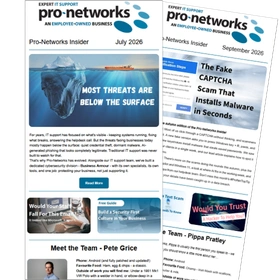
The Pro-Networks Insider
Delivered to your inbox every other month
The scams currently targeting businesses like yours.
A #ProNetTopTip that your team can put into practice in minutes.
Plain English updates on Microsoft 365 and IT changes that affect you.