

TL;DR: Security stacks change shape over time. Products are added to deal with specific risks, vendors keep extending what their platforms cover, and eventually two tools can be doing much the same job without anyone having planned it. The warning sign is a question that should be easy to answer and isn't: what would happen if we removed this? When nobody is sure, every future change takes longer to plan. Reviewing what each security product is there to do keeps the stack understood, but that work rarely fits around projects and support. Co-managed IT support shares the operational load with your internal IT team so there's time to do it properly.
When did you last ask why a tool is still there?
Every security product in your environment arrived for a reason. Something needed covering, the product did the job, and once it had bedded into day-to-day operations your team's attention moved on to the next priority.
That's how it should work. The difficulty is that the environment carries on changing long after the buying decision has been made.
How overlap creeps into a security stack
Vendors add capabilities with almost every release. An endpoint platform starts handling work that used to need a separate tool. Your Microsoft 365 licensing picks up security features that sit alongside a third-party product you bought years earlier to cover the same gap.
Nobody sits down and decides two platforms should cover the same ground. It happens gradually, one update at a time, until the stack you manage today looks quite different from the one you put together a few years ago.
The question that should be quick to answer
The first sign usually comes up in a planning meeting or a renewal conversation: what would happen if we removed this product?
Sometimes the answer is obvious and the discussion moves on. Other times it runs far longer than anyone expected, because nobody is completely sure where one product's responsibilities stop and the next one's start.
A proper review can turn up two platforms raising similar alerts, collecting similar data or providing reassurance about the same area of risk. Neither product is poor, and neither was bought by mistake. Both were sound decisions for the environment as it looked at the time. Duplicate alerting from overlapping tools also feeds the noise problem we covered in our piece on alert fatigue.
Already have an IT team?
Let's see if we're a good fit.
A quick, no-obligation call with our team. No pitch, just an honest look at where co-managed support could help.
What the uncertainty costs
An overlapping stack rarely fails in an obvious way. The cost shows up in slower, more cautious decisions.
Renewals get approved because nobody wants to be the person who switched off the wrong layer. Changes need extra investigation to confirm which product is responsible for what. During an incident, your team may have to work out which console holds the most useful information before they can get on with responding.
None of that appears on a single budget line, so it tends to go unchallenged year after year.
Give every product a clear purpose
Revisiting your security tools every so often is worth the effort. The aim is a stack where your team can state plainly what each product is responsible for. Fewer products may come out of it, or the count may stay exactly the same.
A useful review works through questions like these:
- What risk was this product brought in to address, and is that risk now covered elsewhere?
- Which of its alerts or reports does your team actually act on?
- Where does its coverage overlap with another tool, and was that overlap a deliberate choice?
- Who would notice, and what would stop working, if it was switched off tomorrow?
Some overlap is intentional, and layered defences depend on it. The overlap worth finding is the kind nobody chose and nobody can explain.
Most reviews lead to more confidence than change. Your team comes away understanding how the layers fit together, where they support each other and where they've drifted into covering the same ground. Where a product no longer earns its place, the next steps look much like those in our blog on IT simplification.
Why the review keeps getting pushed back
For most IT Directors the obstacle is time. A security stack review competes with project deadlines, operational issues and everything else that fills the week, and on any given day it rarely feels as urgent as any of them.
How co-managed IT creates the space
Co-managed IT support reinforces your internal IT team rather than replacing it. We take on a share of the day-to-day operational workload, which gives your people room to step back and look at the security stack properly.
For IT teams across Chester, Cheshire, Wrexham and North Wales, that could mean our engineers covering routine support while your team maps out what each product does. It could also mean working through the review together, with our engineers adding a second opinion on where coverage overlaps. Your team keeps ownership of the environment and every decision made about it.
Talk to our co-managed IT team
If you're an IT Director and you're not sure your team could explain your security stack end to end, a short conversation is a sensible first step. Whether you're based in Chester, Wrexham, Cheshire, on the Wirral or elsewhere in North Wales, book a call with the Pro-Networks co-managed IT team and we'll talk through how we could give your team the capacity for this kind of review.
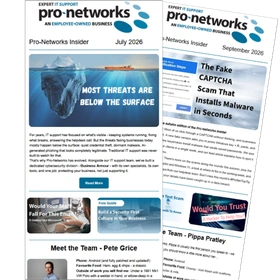
The Pro-Networks Insider
Delivered to your inbox every other month
The scams currently targeting businesses like yours.
A #ProNetTopTip that your team can put into practice in minutes.
Plain English updates on Microsoft 365 and IT changes that affect you.