

TL;DR: Integrations are usually built to solve a specific problem, then fade into the background while the platforms and processes around them keep changing. Over time that creates integration debt: connections that still work but that nobody fully understands. It slows down changes and makes upgrades harder to plan. Reviewing integrations periodically keeps them dependable, but that work rarely makes it onto a busy team's schedule. Co-managed IT support shares the day-to-day workload with your internal IT team so there's capacity to review these connections before something forces the issue.
Quiet until something changes
Few parts of an IT environment ask for less attention than a working integration. Data moves between systems, the process it supports runs, and nobody gives it much thought.
That quiet can be misleading. A supplier updates their API, a platform upgrade gets scheduled, or a project reaches the stage where the surrounding systems have to change. Overnight, a connection nobody has looked at in years becomes central to the conversation, and the team starts to discover how much depends on it.
How integration debt builds up
Most integrations are built for sound reasons. A specific problem needed solving, the integration was the sensible answer and everyone agreed on the approach. Once it was working, it became part of the environment and attention moved elsewhere.
The integration itself may have stayed exactly as it was built. Everything around it kept moving. Platforms have been upgraded, business processes have been redesigned, and the connection now supports a very different setup from the one it was designed for.
Some integrations get updated along the way. Others carry on working just well enough that revisiting them never feels necessary. The debt builds up because the environment evolves faster than anyone reviews the connections that hold it together.
The cost shows up as hesitation
It's common to find environments where every integration is still running, yet nobody on the team is fully confident about what would happen if one stopped without warning.
That uncertainty has a cost. Changes take longer because people want to be sure they aren't breaking something elsewhere. Platform upgrades need more investigation than they should, because the dependencies aren't documented or obvious. Supplier changes that ought to be routine turn into small projects of their own.
The cost tends to appear as friction spread across many smaller decisions, which makes it easy to underestimate.
Already have an IT team?
Let's see if we're a good fit.
A quick, no-obligation call with our team. No pitch, just an honest look at where co-managed support could help.
Why the review keeps slipping
Reviewing integrations rarely feels urgent. There's always a project with a deadline, a supplier request waiting for a response or an operational issue that landed first thing this morning. Each of those wins on the day, and months gradually turn into years.
Treat integrations as operational assets
A useful habit is to think about integrations in the same way as any other operational asset: something that benefits from occasional, planned attention. A periodic review might ask:
- Does it still reflect the way the business works today?
- Does everyone who needs to know understand what it does and which systems rely on it?
- Is it documented well enough for someone else to pick up if they had to?
- What would happen, and who would notice, if it stopped tomorrow?
Working through those questions gives your team a clearer map of dependencies before the next upgrade or supplier change arrives, so the investigation happens on your timetable.
How co-managed IT makes room for the review
Knowing what to ask is the easy part. Finding the hours is harder when the operational workload already fills most of the week.
Co-managed IT support changes that balance. We work alongside your internal IT team, reinforcing it rather than replacing it, and take on a share of the day-to-day workload. That creates room to review the connections holding your environment together on your own schedule, instead of only when a supplier change or a failed upgrade forces it.
For IT teams in Chester, Cheshire, Wrexham and North Wales, that might mean our engineers covering routine support while your own people map and document key integrations. It could also mean working through the review together, with your team keeping ownership of the environment and the decisions, and ours adding capacity and a second opinion.
Talk to us about co-managed IT
If you'd like to discuss how co-managed IT support could give your team time for work like this, whether you're in Warrington, on the Wirral or elsewhere in the North West, get in touch with the Pro-Networks team.
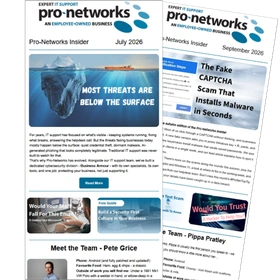
The Pro-Networks Insider
Delivered to your inbox every other month
The scams currently targeting businesses like yours.
A #ProNetTopTip that your team can put into practice in minutes.
Plain English updates on Microsoft 365 and IT changes that affect you.